
- Key Targets.
- Industries Affected.
- Geographical Focus.
- Infection Chain – Operation IconCat.
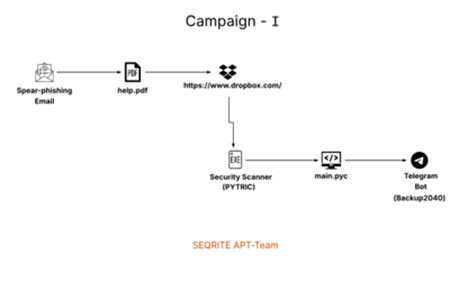
- Infection Chain – I.
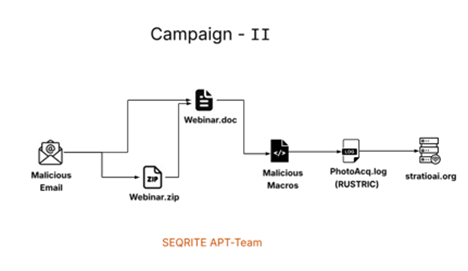
- Infection Chain – II.
- Campaign-Analysis – Operation IconCat.
- Campaign-I
- Initial Findings.
- Looking into the malicious PDF File.
- Technical Analysis.
- Malicious PyInstaller implant – PYTRIC
- Campaign-II
- Initial Findings.
- Looking into the malicious Spear-Phishing Outlook File.
- Technical Analysis.
- Malicious Word Document.
- Malicious Rust Implant – RUSTRIC
- Infrastructural Analysis.
- Conclusion
- SEQRITE Protection.
- IOCs
- MITRE ATT&CK.
- Initial Findings.
- Initial Findings.
- Campaign-I
Introduction
SEQRITE Labs’ APT Team has been tracking Unknown-Clusters [UNG0801], a slightly advanced yet persistent threat entity believed to originate from Western Asia, with activity primarily observed against Israeli organizations. The cluster shows a strong focus on enterprise environments, relying on socially engineered phishing lures written in Hebrew and designed to resemble routine internal communications, such as compliance updates, security advisories, or corporate webinar announcements.
A recurring pattern across the observed campaigns is the actor’s heavy reliance on antivirus icon spoofing. Branding from well-known security vendors, most notably SentinelOne and Check Point, is abused to create a false sense of legitimacy. These spoofed AV-themed decoys are dropped by malicious Word and PDF documents, which act as the initial delivery mechanism. Once opened, the documents lead to the extraction or execution of the decoy content, increasing the likelihood of user interaction and follow-on compromise.
This activity was initially tracked internally by SEQRITE Labs as Operation IconCat, during which two distinct infection chains were identified beginning in the third week of November 2025, both targeting certain organizations across Israel. While the campaigns differ in their implants and supporting infrastructure, the consistent abuse of AV icon spoofing within a narrow operational timeframe, we think that it suggests a shared operator or playbook. Based on this behavioral linkage, SEQRITE Lab APT-Team groups these campaigns under a single activity cluster, now tracked as UNG0801, which is subjected to change, based on future research.
Key Targets
UNG0801 which comprises of both the campaign clusters have targeted a certain set of industries on the selected jurisdictions of interest, which are as follows:
Industries Affected
- Information Technology and Managed Service Providers.
- Human Resources and Staffing Services.
- Software Development and Technology Companies
Geographical Focus
- Israel
Infection Chain – Operation IconCat.
Campaign – I
Campaign – II
Campaign-Analysis – Operation IconCat
As, we previously mentioned that we group the cluster of threat campaigns under the name UNG0801, we also term this as Operation IconCat, as we believe the shared playbook, which involves abuse of AV Icons, of well-known vendors, therefore, now we will look into the depth of the campaigns and implant and other specific details into further sections.
Campaign – I
In, this campaign of shared playbook focusing on AV-abuse, we found the first campaign, which had been abusing the icon of CheckPoint Anti-Malware Vendor by spoofing it, further using it as the logo for the PyInstaller implant which we have decided to term as PYTRIC, acting as a legitimate binary, therefore, we are tracking it as the first campaign or cluster under UNG0801 or Operation IconCat.
Initial Findings.
As at SEQRITE Labs APT-Team, we meticulously track initial access payloads, such as shortcut files, spear-phishing based emails, malicious installers and much more, we did come across a PDF file, which is named as help.pdf.
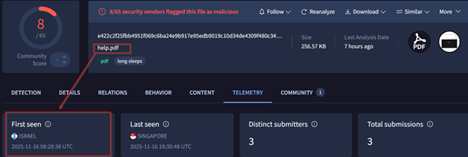
This sample had been uploaded on the public sandbox corpus on the date of 16 Nov 2025, and had been uploaded initially from the geolocation of Israel. Along with us other security researcher also found this campaign.
Looking into the malicious PDF File.
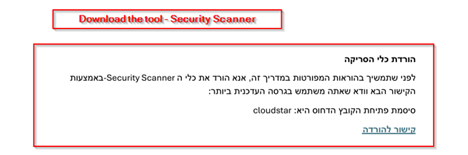
Upon initial analysis of the PDF file, help.pdf, we observed that it serves both as a document-based lure and as a delivery mechanism for the next stage of the infection chain. The document instructs the victim to download a tool named “Security Scanner”, which is hosted on Dropbox and protected with the password “cloudstar”. As part of the social engineering, the document advises users to ensure they are using the latest version of the tool, falsely implying its legitimacy by associating it with Check Point.
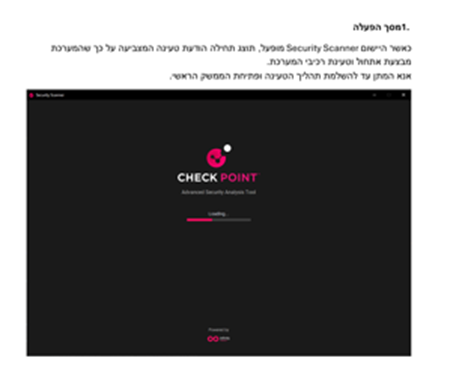
To make, the decoy relevant as much as possible, the PDF also contains logo and image of the start-up screen of the security tool provided by Check Point Anti-Malware Vendor.
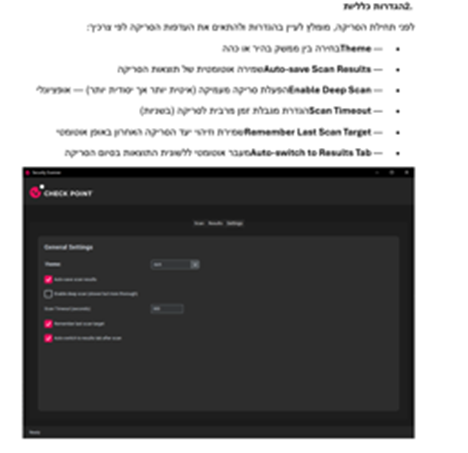
In the next page, the document focuses on providing step-by-step instructions for initiating the scan, including selecting the target drive or folder and choosing between a quick or comprehensive scan mode. It also explains how users can start or stop the scanning process and visually monitor scan progress through an on-screen progress indicator, reinforcing the appearance of a legitimate and functional security tool.
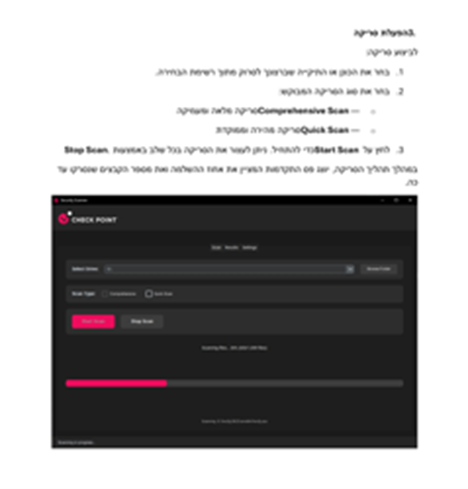
In the third page of this PDF, it focuses on the types of scanning, which are available such as Comprehensive Scan , Quick Scan and much more.
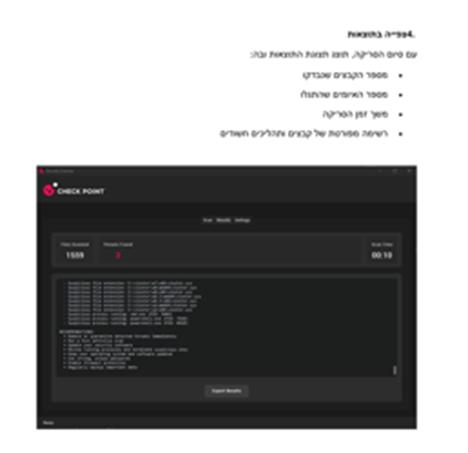
Well, the last page of this malicious PDF focuses on the scan results interface, which is displayed once the scanning process is complete. This section presents a summary of key metrics, including the total number of files scanned, detected threats, and overall scan duration. Additionally, it provides a detailed listing of suspicious files and running processes, along with generic remediation recommendations.

In the next section, we will look into the technical analysis of the second-stage payload, which the PDF manual instructs the victim to download from Dropbox.
Technical Analysis.
In this section, we will now focus on the technical capabilities of the implant, which we track as PYTRIC.
Malicious PyInstaller Implant – PYTRIC.
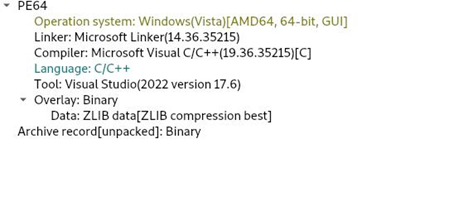
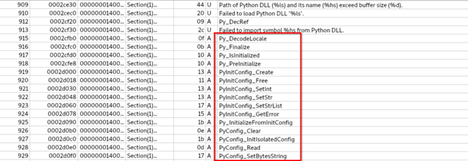
Initially, upon loading the binary into basic analysis tools, we observed that it was packaged using PyInstaller. In simple terms, this means the malware was originally written in Python and then bundled into a standalone Windows executable. PyInstaller packages the Python interpreter, required libraries, and the attacker’s Python code into a single binary, allowing it to run on systems without Python installed. This technique is commonly abused by threat actors as it simplifies deployment while also adding a thin layer of obfuscation, making static analysis slightly more cumbersome.
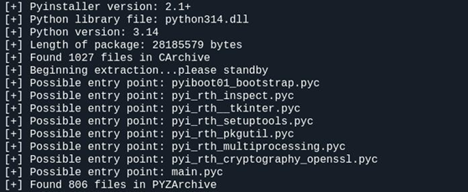
Therefore, we decided to extract the files from this malicious PYZArchive, further upon decompiling this main.pyc file, we found the malicious fragments of the code.
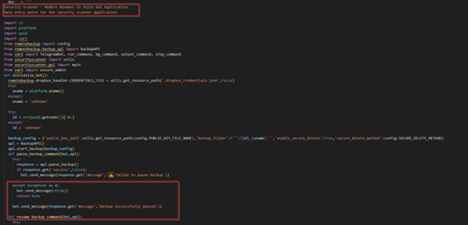
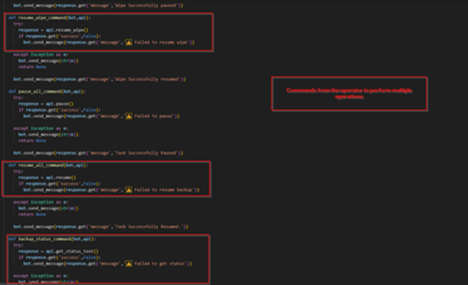
Finally, we can see that the malicious script contains multiple messages to perform certain tasks.
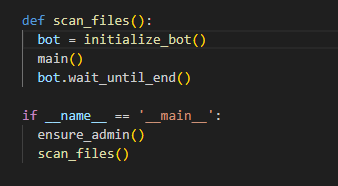
Then, we found a set of interesting functions known as scan_files which basically scans all the files on the target machine and then there is the other function, which is basically performing if the script or the implant PYTIC has certain administrator privileges to perform certain set of tasks.
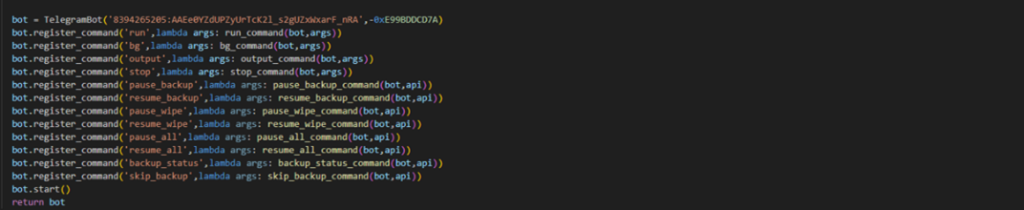
Now, in the final part of this script, we can see that there are multiple commands which were executed from the TA’s end, which perform tasks such as performing system-wide wipe, delete all the backup, check for backup status and much more, making this implant a sort of Wiper, on the victim’s end.
Therefore, we conclude that the PYTRIC implant, is basically a poorly programmed malware, backed up by PyInstaller. Further, looking into the Telegram bot-token, we found that the name of the bot, which had been used to connect to the TA is Backup2040, which had been used to perform the above operation.
Campaign – II
Now, in this second-campaign of shared playbook focusing on AV-abuse, we found the that it had been abusing the icon of SentinelOne Anti-Malware Vendor by spoofing it, further using it as the logo for the Rust based implant, which we have decided to term as RUSTRIC, acting as a legitimate binary, therefore, we are tracking it as the second campaign or cluster under UNG0801 or Operation IconCat.
Initial Findings.
Once we had tracked the first campaign, we later also tracked and identified a malicious spear-phishing based email, which has been uploaded from Israel.
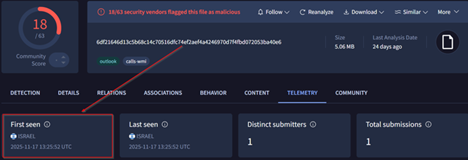
As, we can see that the sample has been uploaded on the public sandbox corpus on the date of 17 Nov 2025. Now, let us look into the malicious Spear-Phishing based email.
Looking into the malicious Spear-Phishing Email-File.
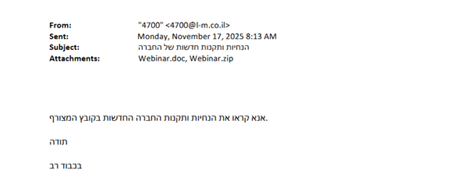
Initially, upon examining the malicious spear-phishing email, we found that it was impersonating L.M. Group, a legitimate Israeli human resources and staffing services company, by abusing the l-m.co.il domain. Upon, looking into the contents of the email, we figured out that the TA had used certain wordings to resemble an internal corporate communication, using a generic departmental sender name and formal Hebrew language, and carried attachments presented as routine company guidelines and webinar materials, that are Webinar.doc and Webinar.zip .
Technical Analysis.
In this section, we will focus on two components of this campaign, the first being the malicious word document, containing macros, leading to the second and final stager, which we track as RUSTRIC.
Malicious Word Document.
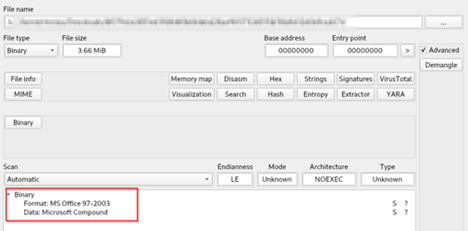
Initially, upon looking into initial file analysis tools, we became quite familiar with the file format, that it is a document file containing macros.
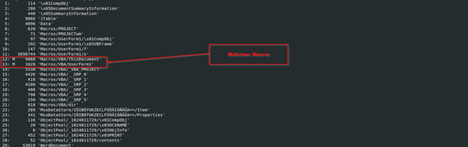
Furthermore, we also noticed that the document is basically corrupted and the sole purpose of the word file is to drop the final stager. Upon looking at the streams, we figured out of all the streams, there are only two interesting ones, containing malicious code.
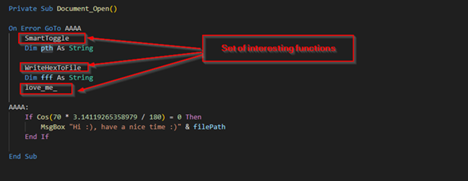
Further extracting the malicious macro, we found that it contains a few sets of interesting functions for performing certain tasks, also we found that the threat actor left a very heart-warming message for analysts and the target which goes as Hi : ), have a nice time : ).
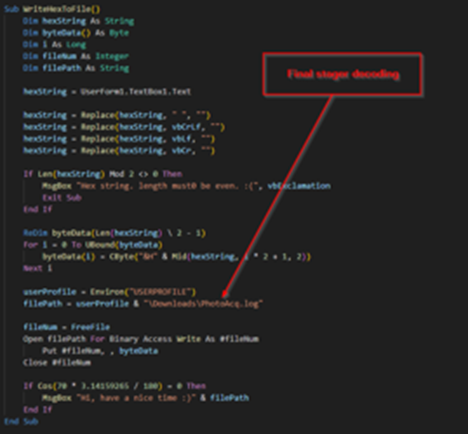
Upon analyzing the function WriteHexToFile, we determined that it is responsible for extracting and reconstructing the final-stage payload from the UserForm1 stream. The function reads a large hex-encoded blob stored within the design-time value of UserForm1.TextBox1.Text, removes all formatting artifacts such as spaces and line breaks, and validates the integrity of the data. It then decodes the hex string byte-by-byte into its raw binary form and writes the reconstructed payload to disk as PhotoAcq.log within the target’s Downloads directory, known as PhotoAcq.log .
Also, we saw a very unique pattern, that the threat actor, loves overusing emotes and repeating and leaving similar messages everywhere across the malicious script.
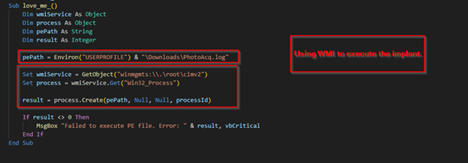
Next, upon looking into the function love_me_ is responsible for executing the reconstructed payload once it has been written to disk. It builds the full path to the dropped file, PhotoAcq.log, located within the victim’s Downloads directory, and leverages Windows Management Instrumentation (WMI) to launch it. Specifically, the macro obtains a handle to the Win32_Process class via the rootcimv2 namespace and invokes the Create method to spawn a new process.
Next, we will look into the final payload, which is RUSTRIC.
Malicious Rust Implant – RUSTRIC
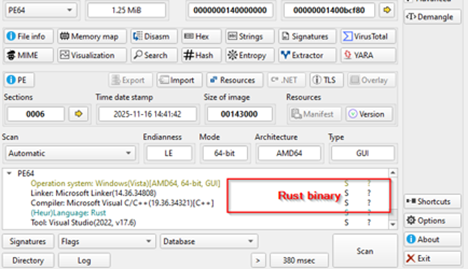

Initially, upon loading the binary into initial analysis tools, we figured out that this is a Rust-based implant.
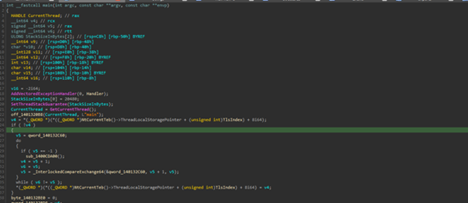
Reaching to the main function, we found that as it is a Rust binary, there are lot of mixture of library as well as code fragments which were of little interest.
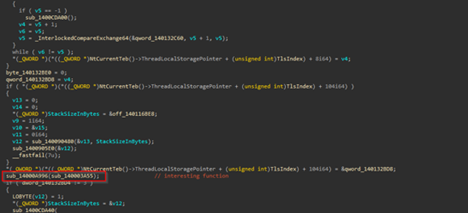
Moving ahead, we found an interesting function, which performs a ton of tasks such as enumerating the list of antiviruses present on the target’s machine.
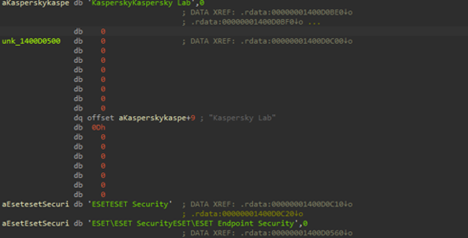
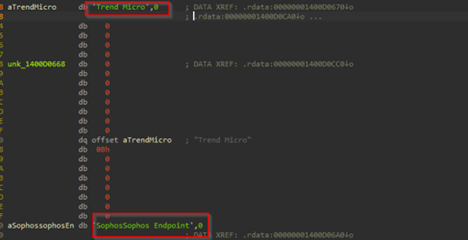
As mentioned, we also saw that it enumerates a total of 28 anti-viruses which include QuickHeal, CrowdStrike, CheckPoint, ESET and much more by enumerating the filenames of the anti-malware agent files, specific folders and much more. The list of anti-malware vendors enumerated by this implant are as follows:
| # | Antivirus Name |
| 1 | Quick Heal |
| 2 | Microsoft Defender |
| 3 | Avast |
| 4 | AVG |
| 5 | Avira |
| 6 | Bitdefender |
| 7 | Kaspersky |
| 8 | ESET |
| 9 | McAfee |
| 10 | Norton |
| 11 | Trend Micro |
| 12 | Sophos |
| 13 | Malwarebytes |
| 14 | Panda Security |
| 15 | F-Secure |
| 16 | Comodo |
| 17 | Webroot |
| 18 | Cylance |
| 19 | SentinelOne |
| 20 | VMware Carbon Black |
| 21 | CrowdStrike |
| 22 | G DATA |
| 23 | Qihoo 360 |
| 24 | K7 Computing |
| 25 | Doctor Web |
| 26 | Check Point |
| 27 | BullGuard |
| 28 | Emsisoft |
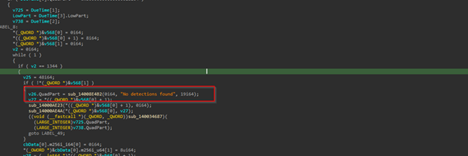
Further, once the enumeration is complete and in case the implant finds out that the certain AVs are not present, it also prints a message that is “No Detections Found”, next, once the AV-enumeration is done, it proceeds to perform next set of actions.

Initially, it executes the command whoami.exe , which is basically a generic behavior performed by implants, although quite noisy.
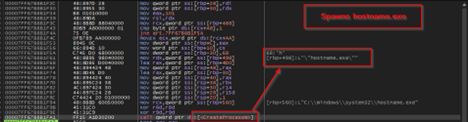
Next, it executes the command hostname.exe , which again is a generic behavior to enumerate the hostname of the target.
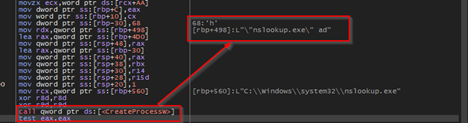
And, the final command, the implant runs is basically nslookup.exe which basically, performing network related operation.
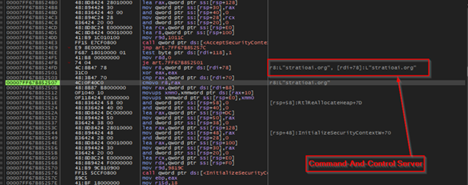
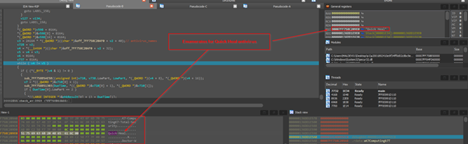
Well, the last but not the least is, we also extracted the address of the command-and-control framework, in this case the implant, had been making multiple attempts to connect to the C2 address.
Now, as we conclude the analysis of this basic implant, we will next head over to looking at the infrastructural based artefacts.
Infrastructural Analysis.
In the first campaign, we figured out that the threat actor had been abusing Telegram for its communication and infrastructural based tasks, whereas, in the second campaign, we extracted the command-and-control from the implant.
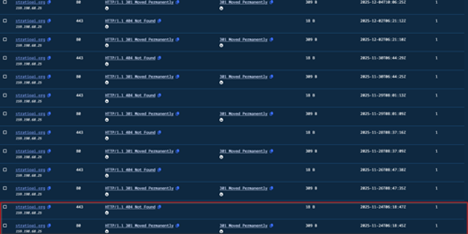
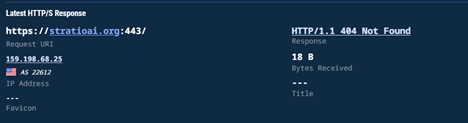
Well, looking into the infrastructural details, we found that there have been multiple redirects to the HTTPS version of the webpage, along with the latest response, which we found, that it had been serving on port 443, which we believe that had been the port for communicating with the C2 server.
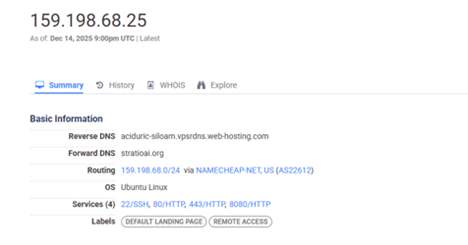
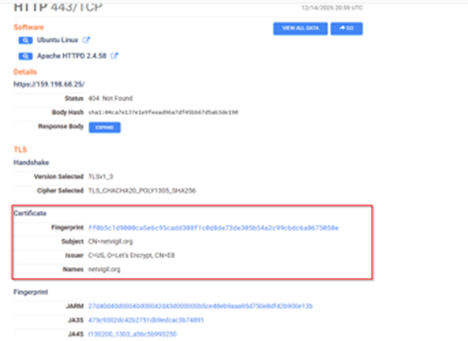
Next, we observed an interesting detail during the infrastructure review. The IP address mapped to the domain was still associated with a netvigil.org CNAME and continued to present a TLS certificate issued for that domain instead of the one we were analyzing. This indicates that the VPS previously hosted netvigil.org and was never fully reconfigured for the new domain. In practice, this type of residue, we believe where the underlying host retains certificates or virtual host entries from an earlier setup, is common on low-cost or repurposed infrastructure often seen in malicious operations.
We believe that the actor simply pointed a new domain to an existing server without cleaning up the older configuration.
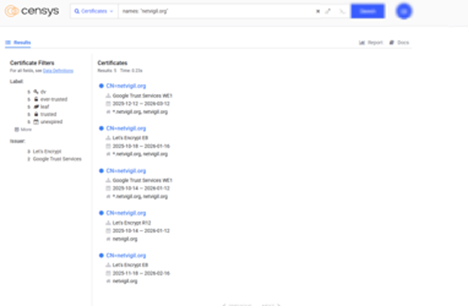
A review of the certificate history in Censys further supports this assessment. When querying for netvigil.org, we identified multiple active and recently issued certificates tied to the same domain, including wildcard entries (*.netvigil.org).
Conclusion
Therefore, we conclude that, although both the campaigns, the motives are different, they share a quite similar playbook for abusing AV-Icons on implants for execution, which binds both these under the cluster UNG0801, the first one abusing Check Point’s icon and theme for the delivery of PYTRIC implant, which performs devastating actions such as wiping system information, while, the other also abuses Sentinel One’s icon and a little similar theme for delivery of RUSTRIC implant, which we believe is only for espionage purposes.
Attribution is indeed a tough and confusing call but based on quite similar playbook and timeframe of the campaigns, we group this under Operation IconCat or UNG0801. While, with a little contradiction, we believe the first campaign, does not intend on data stealing or espionage, whereas the second campaign, focuses on espionage, mimicking the behavior of an Advanced-Persistent-Threat (APT) group.
Therefore, that sums up our research and provided the above reasons with certain confidence of grouping the campaigns under a cluster, which is subjected to change, as well as highlighting the certain differences.
SEQRITE Protection.
- Inject
- Win64
- Trojan.50253.GC
- Trojan.50255.GC
- Trojan.50254.GC
IOCs
| Hash | File Type |
| 6df21646d13c5b68c14c70516dfc74ef2aef4a4246970d7f4fbd072053ba40e6 | Outlook |
| 6f079c1e2655ed391fb8f0b6bfafa126acf905732b5554f38a9d32d0b9ca407d | Documet |
| 77ceeb88a1fe4fb03af1acc589e02aeb156e3b22b110124ce1b25c940b0d9bbe | ZIP |
| 54ebdea80d30660f1d7be0b71bc3eb04189ef2036cdbba24d60f474547d3516a | EXE |
| 2afcac3231235b5cea0fc702d705ec76afec424a9cec820749b83b6299d1fe1b | EXE |
| e422c2f25fbb4951f069c6ba24e9b917e95edb9019c10d34de4309f480c342df |
Host/IP Addresses
| stratioai[.]org |
| hxxps://www[.]dropbox[.]com/scl/fi/e2tctz6iy0s81dcxysbkf/help.pdf?rlkey=4b3uydquzd0h5xe7lk0gk95r9&st=c1qfydwi&dl=1 |
| 159[.]198[.]68[.]25 |
MITRE ATT&CK
| Tactic | Technique ID | Technique Name | How It Applies to Operation IconCat |
| Initial Access | T1566.001 | Phishing: Spearphishing Attachment | Both campaigns rely on malicious PDF and Word document attachments delivered via spear-phishing |
| T1566.002 | Phishing: Spearphishing Link | Campaign-I instructs victims to download a fake “Security Scanner” from Dropbox | |
| T1204.002 | User Execution: Malicious File | Victims are socially engineered to manually open PDF/Word documents | |
| Execution | T1059.006 | Command and Scripting Interpreter: Python | Campaign-I deploys a PyInstaller-packed Python malware (PYTRIC) |
| T1059.005 | Command and Scripting Interpreter: Visual Basic | Campaign-II uses malicious VBA macros in a Word document | |
| T1047 | Windows Management Instrumentation | RUSTRIC is executed via WMI (Win32_Process.Create) | |
| Defense Evasion | T1036.005 | Masquerading: Match Legitimate Name or Location | Both campaigns spoof trusted antivirus vendors (Check Point and SentinelOne) |
| T1027 | Obfuscated Files or Information | Payload is hex-encoded within Word document. | |
| T1218 | Signed Binary Proxy Execution | Malware execution leverages trusted Windows binaries (e.g., wmic, nslookup, whoami, hostname) | |
| Discovery | T1518.001 | Security Software Discovery | RUSTRIC enumerates 28 different antivirus and EDR products by checking known file paths and process indicators. |
| Command and Control | T1105 | Ingress Tool Transfer | Campaign-I retrieves the second-stage payload from Dropbox as part of the infection chain. |
| T1071.001 | Application Layer Protocol: Web Protocols | Both implants attempt to connect attacker-controlled C2 infrastructure over standard web-based protocols. |
The post UNG0801: Tracking Threat Clusters obsessed with AV Icon Spoofing targeting Israel appeared first on Blogs on Information Technology, Network & Cybersecurity | Seqrite.